Exploring Typescript
23 Jan 2025I am new to Typescript, having primarily worked with languages like Java and C. As I begin to explore Typescript, I am excited to see how it builds on Javascript’s features like typing, syntax, and debugging. Compared to Java, TypeScript feels more flexible, especially since it allows optional types.
Thoughts on Typescript
In my ICS 314: Software Engineering class, we have regular practice Workouts of the Day (WODs). Here is one of the WODs we worked on in groups recently. Imagine my surprise when I realized I did not need to add a return type for this function below. In C and Java, I always specified a return type. The flexibility of Typescript is intriguing, which leads me to believe it is a useful programming language. I just need more practice with it.
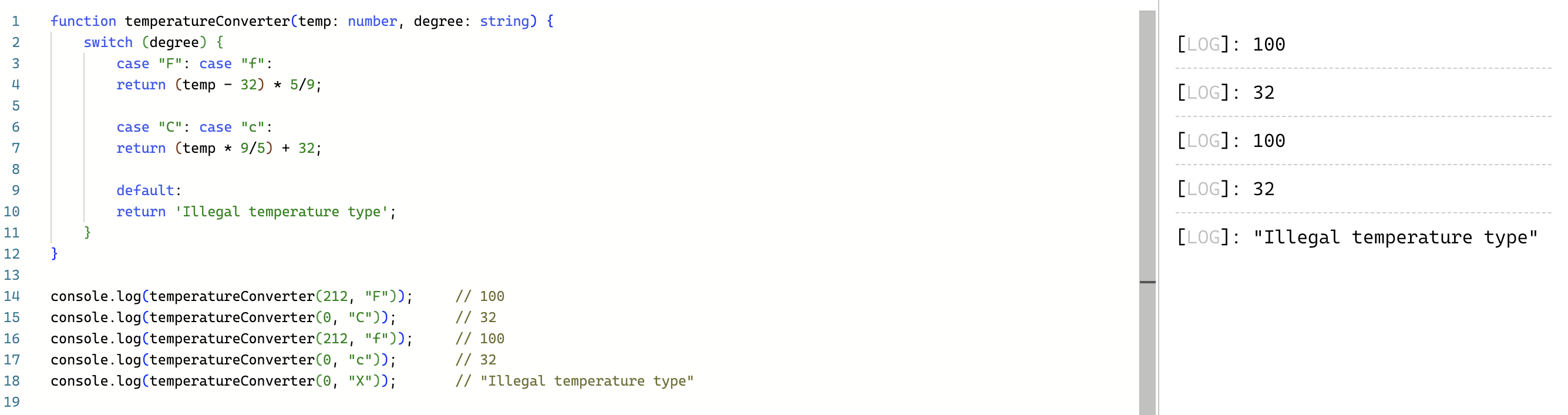
A temperature converter (Celcius to Fahrenheit and vice versa) implemented in Typescript
How is Typescript different from other programming languagues I know?
I need to get used to the syntax of TypeScript, especially how variables and parameters are declared. For example, in TypeScript, I declare a variable with a syntax like this: variableName: type, which differs from what I am used to in Java and C. In those languages, I typically declare variables using type variableName. In TypeScript, using let and const for variable declarations is intuitive. If we want to reassign the value of a variable, we declare it using let. If we want the value to stay constant, we use const. Though this syntax feels a little unfamiliar, I know dedicating time to getting comfortable with Typescript will solve that.
The purpose of the WODs
As a beginner, it is easy to read tutorials and follow along with basic examples, but the real test comes when I have to solve problems. The WODs are designed to test our coding skills. At first, I thought they were stressful. However, I see now they are a great opportunity to test our problem-solving skills. While we might not be working under a time crunch in the real world, familiarizing ourselves with common problem patterns helps us become more efficient programmers.
return type: indicates the kind of data the function returns (e.g., string or number)